
Publications
-webp(85)-o(png).webp?token=a835857ea9acc9ac0a9fc82a8e3bc416 "Repats Without Restrains - 12 Questions with Serine Petrossian")
Have you seen the “Thank You” music video by Dido with the cute little house in the middle of two giant corporate buildings? That’s what 12 Tables always reminds me of. Located on 6 Alexander Spendiaryan street in the heart of Yerevan, this little family-run business has a somewhat unassuming feel to it. It’s one of those places that you want to keep as a secret, but also can’t wait to rave about. Walking in, you’ll find yourself pleased with a fully “homey” atmosphere, from the DIY interior design to the smell of delicious food that takes one straight back to mum’s. In a city of corporate restaurants, bars, and cafes, 12 Tables feels like a warm hug.
A lot of that has to do with the current owner, Serine Petrossian, a repatriate from Iran who acquired and has been running the place for a little over 5 years. We sat down in one of the coziest corners of 12 Tables for a round of 12 questions, sipping tea and coffee along the way.
1. Let’s start at the beginning. What made you and your family leave Iran, and why was Armenia the place you chose to build your next chapter?
Let’s start with “Why Armenia?” This was always the case of “Where else but Armenia?” for our family. There were no alternatives. That being said, my family went through a revolution and a war [Ed. note: Serine’s referring to the Iranian Revolution of 1979 and the Iran-Iraq war that followed.], as a result of which half of our family ended up in the USA and other countries. But my dad was always against “escaping” that situation.
Even in the 80’s, my mom kept saying that we should move to Armenia, but my dad was very clear that he wouldn’t take his children to a Soviet country. Later on when there was a breeze of independence in the air and tours from Tehran to Armenia began, dad decided to come and see what sort of place this was. He visited in either March or April [1991], returned to Tehran, and immediately told my mom to take us to Armenia for a tour.
We arrived in Armenia in August on a tour that was supposed to take 15 days. We returned on September 24, meaning that we stayed here to witness the independence take place. It was a headache though - we had to go to Ovir to extend our visas and so on…
The Iran-Armenia border wasn’t open at the time. You had to go from Iran to Turkey by bus, then reach Nor Bayazet to hop on a train to Gyumri. When you got to the border [Kars], you had to change trains because the railways were constructed differently. You had to take all the luggage off and load it onto the other train. From Gyumri to Yerevan, we took a bus. My mom was so excited the entire time and when people asked her if she was visiting as a tourist, she replied: “I’m not a tourist. I’m on a pilgrimage.”
Anyway, after all this, we stayed and made Armenia independent [chuckles] before returning. I was 10 years old at the time but I remember that the Iranian officials confiscated our passports once we reached Iran because they told us we’d been in the Soviet Union. We asked “What are you talking about? What Soviet Union?” 10 days later, they returned our passports and told us the same thing. “What Soviet Union?”
There wasn’t a question of choice. We visited, and we decided to repatriate. My mom wanted to move even during those rough years in the 90’s. But both myself and my brother insisted that we move only after finishing school. It’s tough to detach from all that, you know.
2. Before moving, what did you imagine life in Armenia would be like? What turned out to be accurate, and what surprised you the most after arriving?
Um, I don’t think there were too many surprises for me. I spent 3 months here every summar from 1991 to 1998 when I moved. By then, my mom was already here with my brother - who moved in 1996 - and they were both studying. We managed to buy a house. So from these aspects, there was nothing that surprising.
The surprises came later, during my university years and when I began to find friend groups. These were mostly personal and not related to the expectations we had from the country itself. There was no culture shock or anything like that because I’d been visiting back and forth so often.
3. What were the hardest moments during the repatriation process? Was it paperwork, work opportunities, housing, mentality shifts, or something else entirely?
University life…
I didn’t have any issues finding friends because my brother already had a collective and I just came and got integrated quickly. But when I entered university, it was a whole different scene. The mindset here about education and what a university is supposed to be was very disappointing for me. That’s why I couldn’t get integrated there and ended up switching universities and eventually, well…
As for work opportunities, yes. It was almost impossible to find a job back in those days.
4. Was there a specific day or event when you felt: “Okay, this is home now”?
I’d say that day in 1991 when I was crying “I don’t want to leave.”
5. How did the idea of entering the food and beverage world appear? Was owning a café always a dream, or did the opportunity find you?
Uh, no. I never thought about it. It was sheer happenstance. My ex-boyfriend had opened a cafe here back in I think 2003 and asked me to help him out, which I did. Then a restaurant called The Club opened, and I worked in their art gallery/shop. Then another friend opened a place and I helped out - all for free [chuckles]. At some point, I told myself “OK, Serine, you need to start earning money. How long can you go on just helping people?” Coinciding with that, the cafe that had become my home, changed into a pub and this was where I officially started working. It all snowballed from there until I left Armenia.
When I returned later, it was one of the only things that I had hands-on experience with, even though I had worked in a friend’s publishing house earlier. This industry [food and beverage] was where I felt relaxed working in because I had so many friends who were in it. Especially at an older age, without official training, without “proper” understanding of Russian, finding a job in any other industry would’ve been extremely hard.
6. Why 12 Tables? What attracted you to this place, and what did you want to preserve or change when you took it over?
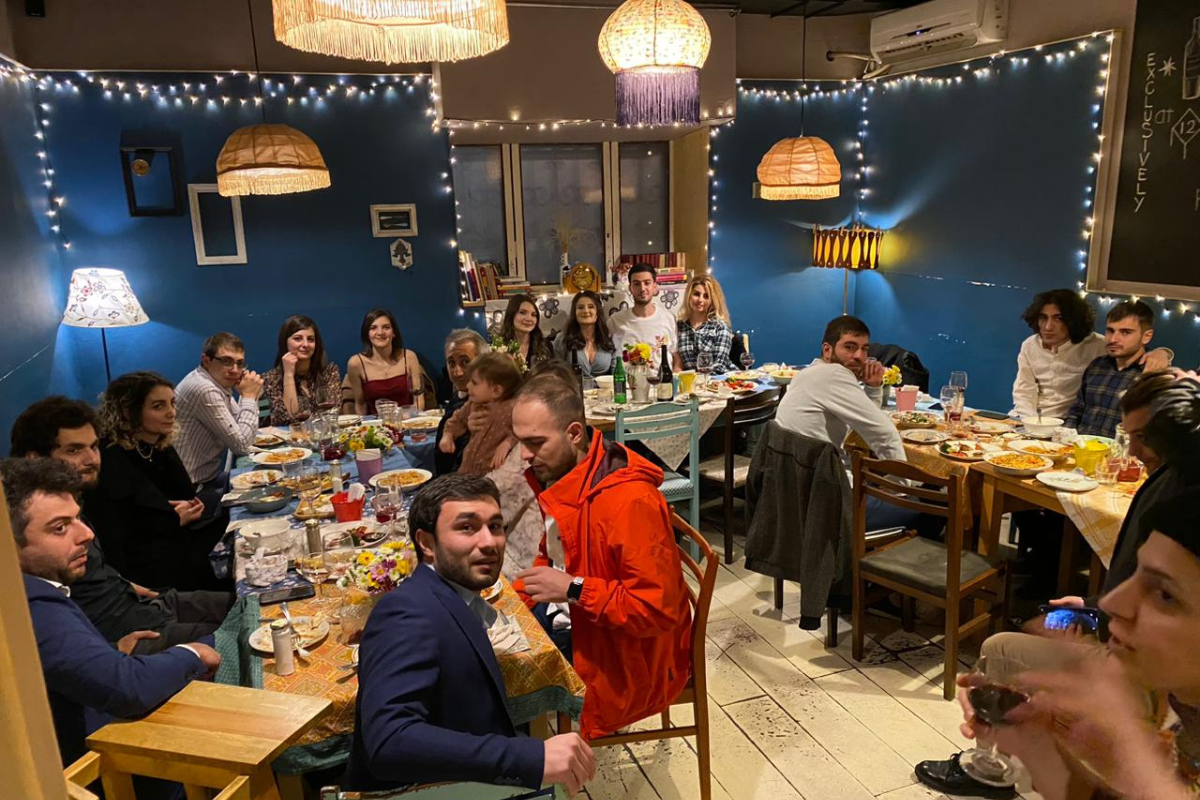
12 Tables was a complete coincidence. This is a very old establishment, and I used to be a customer here. It was one of those places where I felt comfortable, especially after returning to Armenia. The girl who established it back then…she was great to have conversations with and we were on the same wavelength. When I came back after three or four years and didn’t know what to do, she - by chance - told me that she intended to sell the place, leave Armenia, and basically go live the same life that I had just returned from! [chuckles]
I realized that this was the perfect business. Concept-wise, I had nothing to change here except for some minor things. The clients were there already, and she was happy to sell it to me because she wanted to sell it to someone who at least had the same mindset as her. It was just a lucky coincidence.
There’s no goal to masterplan to change anything in Yerevan with this place. It’s been the way it is, and it continues to cater to a specific demand. Some have forgotten it, but that’s OK. But, yeah, that whole transaction went very smoothly.
7. For people who only see the cozy atmosphere and good coffee; what don’t they see? What does a normal day of running a café in Armenia actually look like?
Serine’s eyes roll back as a cynical smile appears on her face. She takes a deep breath and continues.
There are SO many things to take care of. You walk in and you hear: “Serine, this thing is broken. Serine, you forgot to order this. Serine, we forgot to do that.” I think every business is like this. Being a small establishment without a large staff, everything is on your shoulders. There are a lot of daily challenges, starting from your preferred items not being available - which is something you come across a lot in Armenia. For example, the Lars border will close and a specific cheese you buy will be unavailable for 2 months. And you’re like “Oh, OK! Let’s run to the next store, maybe they have some left.”
In one of life’s epic ironies, a member of the 12 Tables staff approached us and interrupted the interview to ask Serine what to do because a specific item wasn’t available from the vendor. Hilarious!
Yeah, those things, and every maintenance starting from the electricity to the faucet, needs my attention. Then there’s the case of our customers. They’re of a different quality compared to places that cater to larger crowds. Mine have specific needs to be met, and it can sometimes be challenging to pull that off. Then there’s the logistics, the paperwork, the municipality deciding to rewrite the rulebook overnight…that’s all on you as a small business owner. But the silver lining is that you have family and staff who take care of this business as if it’s their own. Customers can feel this, and the staff is like family after working in a small place for so long.
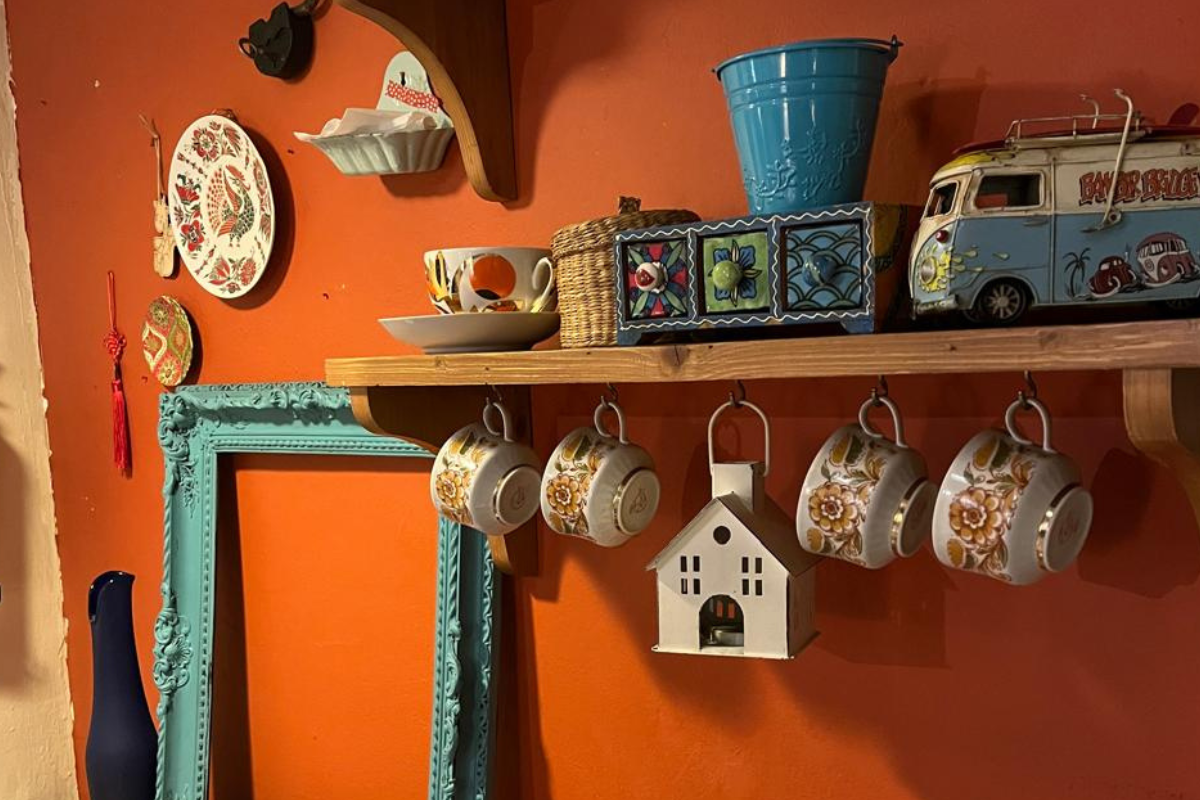
8. You mentioned paperwork. You’ve had this place since 2020. Have there been any improvements in paperwork, such as processing and digitalization?
The improvements have been minor. They haven’t made anything easier. The main improvement is that they’re trying to digitize the processes, but it still takes the same amount of time. They’ll tell you that you have to do everything online, but then that one paper shows up which you need to get physically signed by someone at the municipality, only to scan and upload it later…
Government websites tend to crash a lot, especially when you try to login. There are signs of improvements, nevertheless. For example, government offices are now more organized. There was a time when you’d have to squeeze your way into a room of people chain smoking and looking at you with puzzled faces. Now there are windows, you take turns…they’re really trying to improve, but often fall short of doing so. The intention is there, but the end result is still lacking.
9. What has Armenia given you as an entrepreneur that you might not have found elsewhere?
The cultural aspect of it all. The fact that I have such a tight-knit circle of friends and family who are always eager to help me when I’m in dire straits, whether it’s lending me money to make my monthly payments or anything else. It’s that cultural and “people” factor that’s unique to Armenia in all spheres, including business. Outside of that, sorry, but I think I’d be a millionaire by now doing this same thing in Europe!
10. Many repats dream about opening small businesses. What is one thing you wish you knew before starting?
Both in Armenia and everywhere else, the restaurant and cafe business is considered one of the hardest to get into. The rate of places opening and closing is very high. You can clearly see this when you walk in the center. [At the time of this interview, the Irish pub on Parpetsi street had shut down after more than 16 years.] People need to know this going in, and I think the rates of places closing are even higher in Armenia due to the not-so-decent conditions for small businesses.
Sadly, you need to know that in order to pull it off, you’re going to have to break a small law here and there, even on paper. Because otherwise, it’s impossible to keep a small business going. If you have a lot of capital to invest, sure. Open your place and do everything by the book.
As a small business, however, you’re facing so many laws and regulations. Some of them aren’t even relevant anymore, but can be used against you at any given time. “Oh, you didn’t do this? We’re going to fine you even though no one bothered to check this law for the past 6 years.”
I’d be happy if the law was strict in everything. Especially when it comes to food inspections. I’ve been in enough kitchens in Yerevan to say “Why are we eating out?” I’m so glad that I have the 12 Tables kitchen and at least know that I can eat here in peace. We were trying to hire some cooks, and when they saw the kitchen here - which isn’t that different from a home kitchen - they were surprised at how clean it was. The inspection should be everywhere, but it’s not. Enforcing it and abiding by food hygiene laws can actually be good for businesses, because the ones that don’t comply will be driven out of the competition. That way, establishments who are trying to make an honest living will stay open.
Other than this, it’s tough to get information on the hundreds of laws and regulations out there. There’s no unified database. The Russian influx had some positive effect on this, because the expats created Move2Armenia, which is a very helpful platform and source.
But yeah, whoever wants to get into this business needs to know that they need to be a step ahead and ask around for information on what to do and how to do it. They need to be prepared for surprises.
11. How has this journey changed you personally?
I’m not sure. Maybe others will answer this better about me, haha! It hasn’t changed me much. Maybe it’s made me focus more on myself and my business. It hasn’t changed my personal values at all. In terms of social life, well, it doesn’t exist anymore! [Chuckles] There’s no time. I’m always here. Whenever I have some free time, I come here. There’s just so much to do.
Sometimes you feel like even though you’re surrounded by friends and family, you’re still alone and you have to fix this chair, because there’s no one else who’s going to do it for you.
12. When someone walks into 12 Tables today, what feeling do you hope they leave with?
I hope they’ll think about returning the next day. A lot of our customers are like that. If they’re close, they come every day. Or if they’re tourists and they visit the next year…[Another irony, another interruption by staff]. Yeah, they visit next year or send their friends here. We’ve had a lot of cases of couples visiting from Ireland, Austria, and many other places. I hope that they’ll tell the next person about us or visit with them. Returning customers is the biggest compliment in this business.
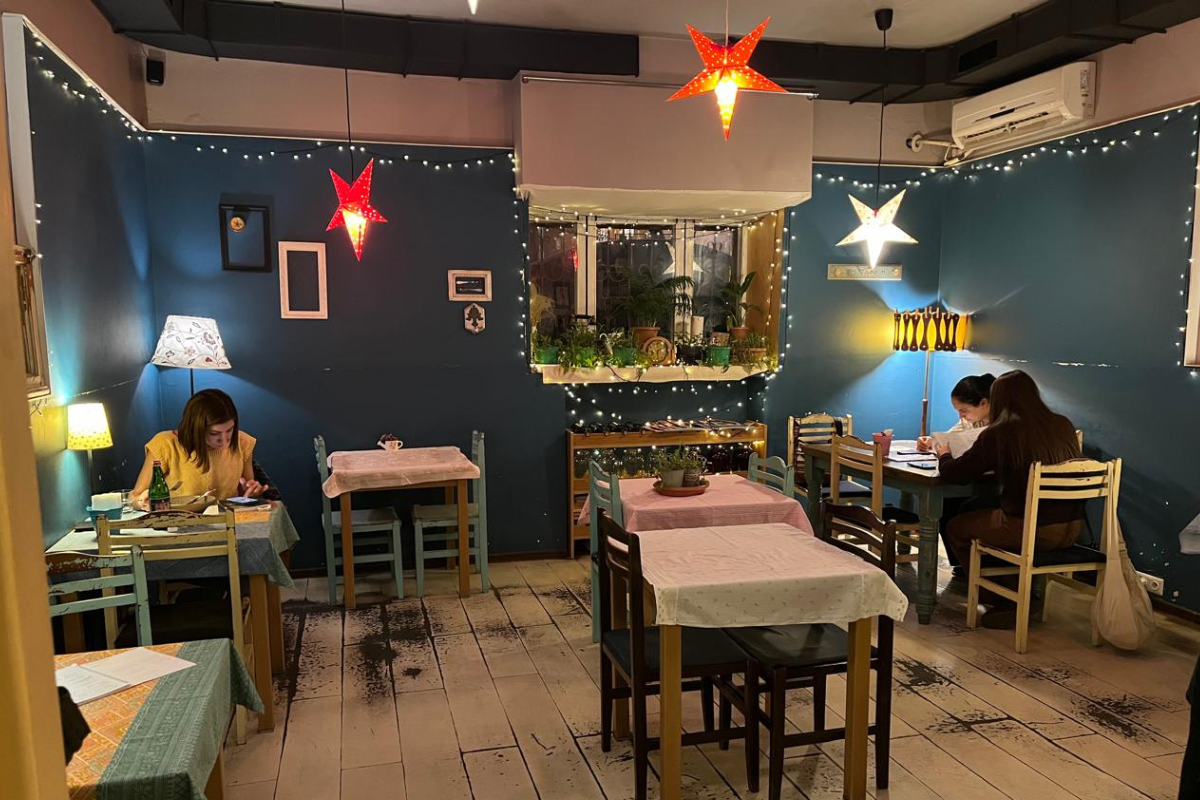
by Nareg Abedi Masihi

-
News
-webp(85)-o(png).webp?token=d92fee26fe94722600393448f07de612 "Arriving in Armenia: How to Exchange Money at Zvartnots Airport Without Overpaying") 25.02.2026Arriving in Armenia: How to Exchange Money at Zvartnots Airport Without Overpaying
25.02.2026Arriving in Armenia: How to Exchange Money at Zvartnots Airport Without Overpaying
-webp(85)-o(png).webp?token=339120d84b4fffad516cdf16da05e78f "To Frankfurt and Back Again: Returning to Armenia")
-webp(85)-o(png).webp?token=0f42b0b6495e56f8d4c718a8194ddb85 "Repats Without Restrains - Candid with Ara Yeramian (Part 2)")
-webp(85)-o(png).webp?token=413d245f6df5612dcb1aaf700e0e040b "Understanding Armenia’s Labor Law - A Practical Guide for Repats - Part 1")