
My Experience
-webp(85)-o(png).webp?token=4b4ad81ebe2b3ba4df37e4ff14e3426a "To Work Without the Right to Give Up. Artush Yeghiazaryan")
Fighting Against Mine Exploitation as a Starting Point for Repatriation
Having received an education and lived abroad for many years, Artush Yeghiazaryan, a native of Leninakan, one fine day in 2018 returned to his hometown — now Gyumri, formerly Leninakan — bringing with him solid professional experience.
The decision to return home was not made immediately; moreover, it came only after nearly five years of active work in and for the homeland: “In 2012, like most Armenians who do not live in Armenia but live with Armenia in their hearts, I came across a Facebook post about a group of young people who were fighting against the opening of a mine in Teghut. This situation had a strong impact on me; I contacted them and offered my help. We became friends, and the story of the mine became the starting point on my path back home.”
Artush brought his professional knowledge and skills into this struggle and suggested a change in approach: if you say that exploiting a mine is bad, you need to provide objective information as to why and present an alternative. The alternative became the sale of honey, which was produced in large quantities in Teghut.
“From 2014 to 2016, we sold Teghut honey in Yerevan, and we did it on a volunteer basis. Our goal was to show an alternative, because the people of Teghut were divided: one part supported the mine’s operation, the other was against it. We showed another path — having a steady income from honey production instead of 200,000 drams per month for 10 years of mine exploitation,” says Artush Yeghiazaryan.
Founding “Herbs & Honey” and Returning Home
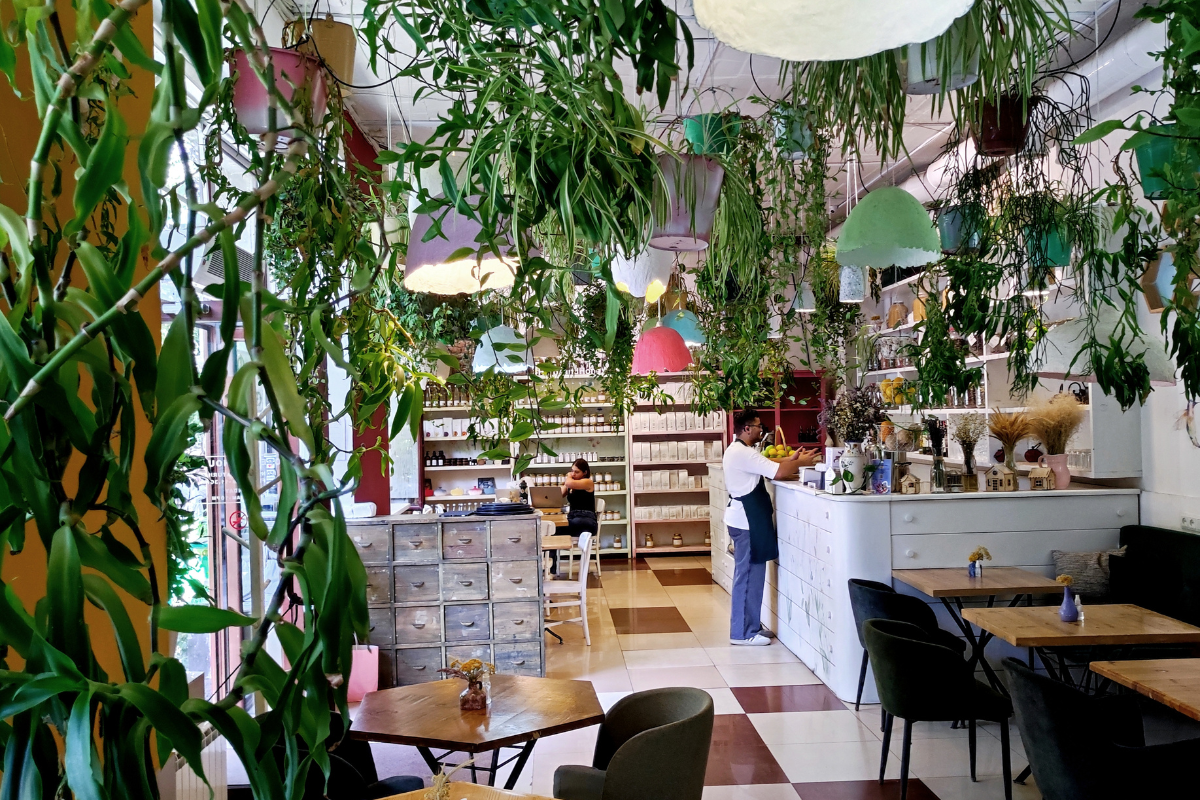
This struggle became the beginning of a love for what was being done on a volunteer basis. The idea took root and turned into a long-term project: the hero founded the company “Herbs and Honey” and later a Herbs & Honey restaurant-teahouse opened in Gyumri.
At the initial stage of its establishment, the company provided a market for honey producers from both Lori and Yeghegnadzor; now it is forced to purchase honey only in Shirak province. But in the long term, the goal is a large market in Armenia with products of high standards, which will make it possible to enter the international market.
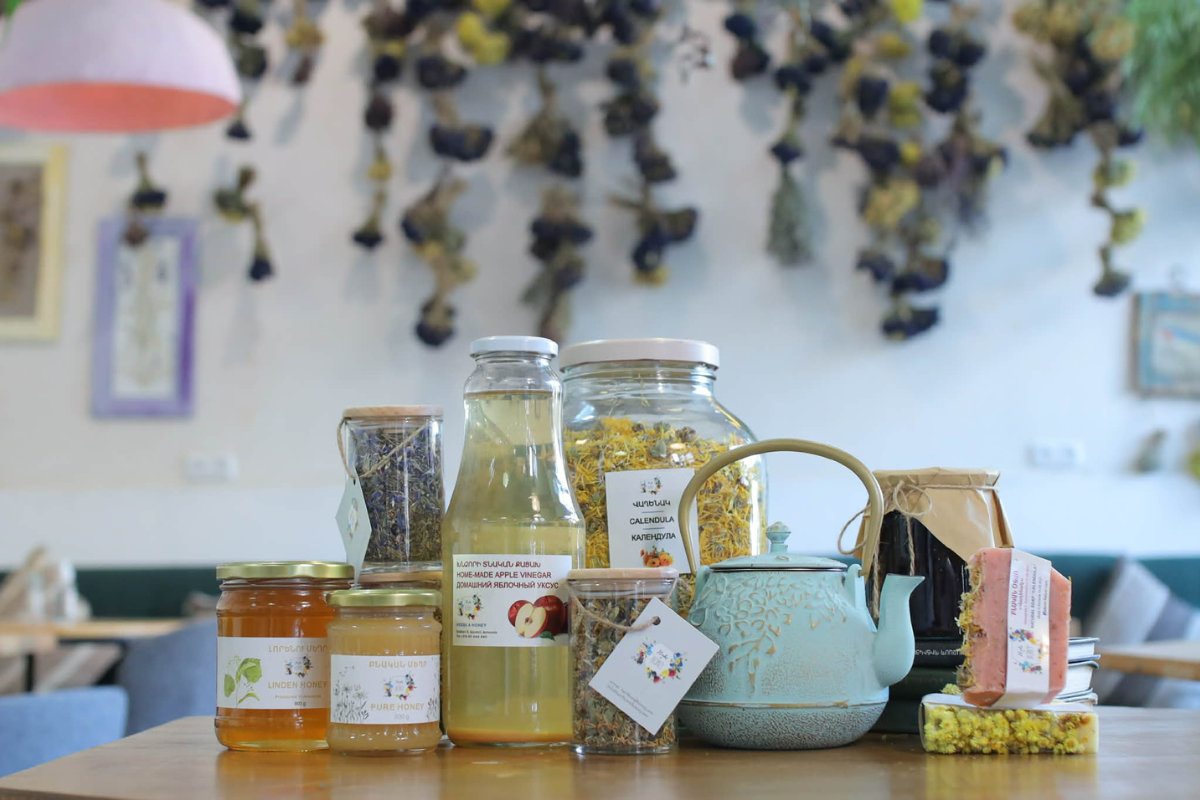
The company “Herbs and Honey” also buys medicinal herbs and dried berries from villagers, and on their basis produces both individual teas and assortments. Also for sale are homemade vinegar and natural cosmetics produced on the basis of honey.
“The Gyumri market is not yet formed; for us it was both a problem and a privilege. A problem because the market is small and there are few consumers; a privilege because the market is unsaturated — there is room to develop and expand. It is hard to break through in Yerevan; here you are one of the few. And our project stands out, even on the scale of Armenia,” Artush continues.
Developing the Business Idea in Ashotsk: Opening a Hotel
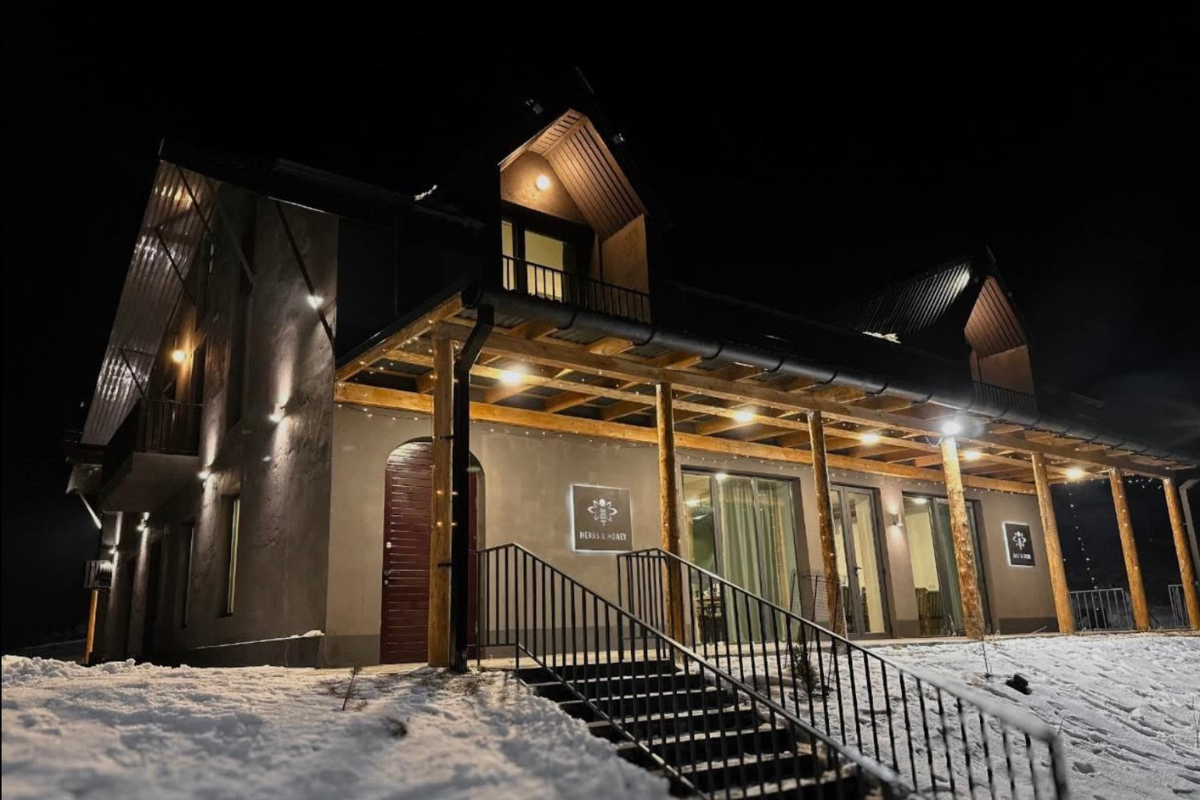
Once a certain stability was achieved in the business, the company opened the Herbs & Honey boutique hotel in the village of Vardahbyur in the Ashotsk district. The hotel operates in the best traditions of the restaurant-teahouse opened years earlier: “Before I finally moved to Armenia, I used to come to Ashotsk with friends. I met a family from whom we eventually began buying wild herbs for our teas. I fell in love with these places; later I was here in the mountains with a large group, and when it was time to rest, I thought: it would be great to have a place for rest and food here. Later, when I saw a house for sale in the village, I bought it; we built a second floor and opened the hotel. We have 8 comfortable rooms with mountain views, a beautiful atmosphere, and far-reaching plans,” the hero presents.
This is already the third winter for the hotel; according to the founder of “Herbs and Honey,” in two more winters it will be possible to reach a positive dynamics: the first few years are always difficult, but since the conditions are good and nature is rich, development is inevitable. As was the case with the restaurant!
On a 3,000-square-meter plot of land purchased not far from the hotel, Artush plans to create an agrotourism center where vegetables will be grown, so visitors will have homemade village food.
The founder of “Herbs and Honey” is also engaged in promoting the region: in the Ashotsk area there are national parks and pools, lakes, rivers, and monuments. In spring and summer, hikes are organized around the region to get acquainted with its richness, followed by gastro-parties and warm evenings at the hotel.
Artush Yeghiazaryan is convinced that the key to his business success is uniqueness. Many people around him thought the idea would not work, but it worked for the very reason it was expected not to work. The restaurant and its concept were very modern, and Gyumri residents responded to them with misunderstanding. According to him, it is important to understand a problem and find its solution: it was necessary to adjust to the market, to adapt — and that was done, while preserving the distinctive “signature style.”
Everything Depends on the Ability to Act
The hero, like no one else, knows where daily purposeful work leads. People, in his opinion, have become accustomed to a sense of inferiority that guides them throughout their lives, even though the region they live in is very rich and offers many opportunities for development. Inferiority and the lack of desire to develop and grow are the norm in Armenia. The norm is a destroyed road, the absence of gas and transportation, a gray atmosphere: “We planted trees here, distributed them to villagers as well; in summer we plant flowers; we have beautiful lighting. Recently, several residents of the village expressed a desire to have the same — this is how you need to change the atmosphere, change this grayness and, with it, the established norm. We need to self-organize; every village can do something; local self-government bodies have their own important function in this process. I know that our work is an example for villagers, for local self-government bodies, and for other communities. We all talk about stopping migration as a strategy, but the strategy should be something else — comfortable living!
When I saw the beauty and wealth of the region against the background of extreme underdevelopment, I realized that something was wrong here: how can you be poor while living in such a rich environment? For me, underdevelopment is not a drawback but an advantage, because it provides enormous space for growth, creativity, and the opportunity to become a pioneer for the region. I am sure development is inevitable; we need to take control of the process and accelerate it. We simply need to see opportunities, create a vision, clearly define long-term goals, create a strategic plan, and implement it. Everything depends on our ability to act — that is exactly what I did within our projects in Gyumri and in Ashotsk.”
Retrospective and Reality, the Diaspora and Armenia
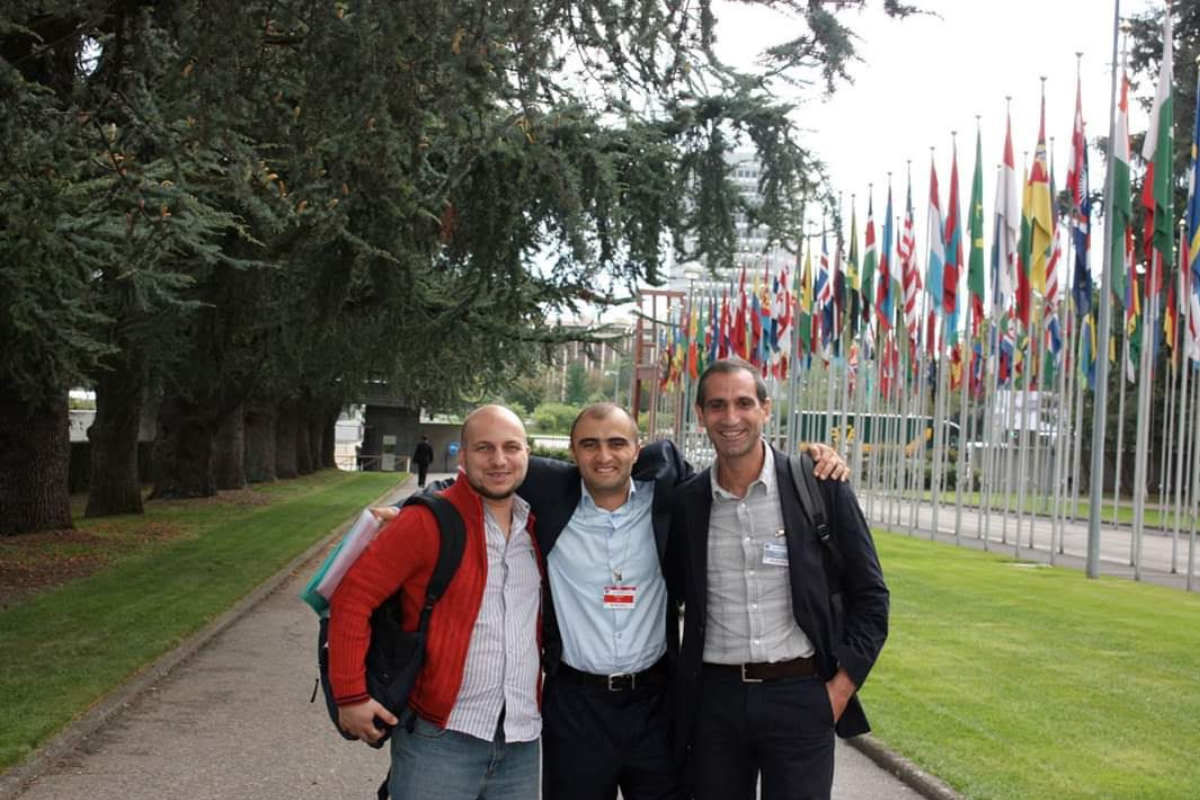
The identity crisis that Artush experienced after several years of living in Switzerland provided an opportunity to get to know the Armenian diaspora and to see the root of the problems of the Armenian nation. Visiting the Armenian church in Geneva, and then being elected to its Council, offered a chance to see the diaspora from the inside. In the course of his public activity, Artush Yeghiazaryan — who also specializes in international relations — began asking the diaspora many questions, for example, why it allocates so few resources to the Republic of Armenia and a very large amount for the recognition of the Armenian Genocide?
“Opposing the Armenian community was the Turkish community, which was very systematically managed by Ankara in the direction of denying the genocide. That is, we in the diaspora fought for the recognition of the Armenian Genocide outside Armenia, while their policy of denial was developing in cooperation with their state. I found like-minded people; we were convinced that the diaspora should put Armenia’s development first, which in turn would lead to a more productive struggle for genocide recognition. That is a different strategy.”
The hero has a conviction: any diaspora exists as long as there is a heart—Armenia. He carried out systematic work and advocated strengthening ties with Armenia in the last years of his life in Switzerland, and when a project was taking shape in the homeland while the diaspora continued moving in the wrong direction, Artush experienced a change in consciousness: “I too, like most of those who do not live in Armenia, complained and accused; and when certain changes happened, I asked myself: okay, and what are you doing, besides complaining and accusing?! I worked and kept accusing, then another stage of consciousness came: I stopped accusing and continued working. It is very important here to show by your own example what you say out loud.”
A Path of Personal Evolution
The long journey of developing “Herbs and Honey” became a path of evolution for Artush Yeghiazaryan as well. His thinking, like his business, underwent changes under the influence of Armenian reality, but it was a path of only gains: “I have no right to give up! I acquired this mindset here; I learned to live in an environment that was alien to me, but I accepted reality. But I also learned to move forward in this environment, to develop within it. Maybe subconsciously I’m building a little Switzerland here?! We ourselves must be the changes we want to see around us. Yes, the process is slow, but it is happening. For rapid development, state levers are needed.”
Artush teaches at the Gyumri branch of the Armenian State University of Economics and communicates a lot with young people. His lectures on “Introduction to Business” are an opportunity for youth to tap into his rich professional experience, discuss their plans, and receive advice. Artush sees Armenia’s bright future precisely in the youth. And also in the ability, the capacity, and—most importantly—the desire to protect collective, not individual, benefit, because that is what turns a people into a nation and a state.
Optimism as a Solution

Meanwhile, the hero continues to “drip” his optimism onto everyone and everything that appears around him. Optimism, as he believes, is not a utopia; it is a decision—a decision to stay positive, a decision to create. After all, the world belongs to creators, creators in reality. The world belongs to those who have a vision. And Armenia is a great place to realize one’s visions: “Many think that moving here is a kind of sacrifice for the sake of the homeland. Armenia is not a place for self-sacrifice; it is a place for implementation, for enrichment. In big countries, you may be just a grain of sand in the ocean, but in Armenia—an initiator and participant in major changes.”
Interview by Nare Bejanyan
AI-translated from the original Russian article: «Трудиться без права сдаваться. Артуш Егиазарян»․

-
Personal Stories
-webp(85)-o(png).webp?token=5cecf3cb19b73bb61d86cd8beec1203a "Healing, Crying, and Rejoicing in Her Homeland: The Journey of Serine Kazaryan") 09.02.2026Healing, Crying, and Rejoicing in Her Homeland: The Journey of Serine Kazaryan
09.02.2026Healing, Crying, and Rejoicing in Her Homeland: The Journey of Serine Kazaryan -
Personal Stories
-webp(85)-o(png).webp?token=b0b8f44ff3db826c91e2f90062960e31 "“Building should be based on what unites us.” Lusine Khumaryan") 17.12.2025“Building should be based on what unites us.” Lusine Khumaryan
17.12.2025“Building should be based on what unites us.” Lusine Khumaryan
-webp(85)-o(png).webp?token=bd67bcb312e70768a1104afb38cc06f5 "A New Home Where Jazz Plays: Mikhail Fominykh")
-webp(85)-o(jpg).webp?token=b1cb111a56e1834ffd8f0229030f8815 "Where Dreams Take Root")